Showing posts with label National Debt. Show all posts

Tuesday, January 24, 2012

11 stunning revelations from Larry Summers’s secret economics memo to Barack Obama

From: The Atlantic

A lengthy piece in The New Yorker looks at policymaking in the Obama White House. A key source for writer Ryan Lizza is a 57-page, “Sensitive & Confidential” memo written by economist Larry Summers—eventually to be head of Obama’s National Economic Council—to Obama in December 2008. Here’s some of what I learned about Team Obama’s thinking as the financial crisis was exploding, followed by quotes from the memo itself:

1. The stimulus was about implementing the Obama agenda.
The short-run economic imperative was to identify as many campaign promises or high priority items that would spend out quickly and be inherently temporary. … The stimulus package is a key tool for advancing clean energy goals and fulfilling a number of campaign commitments.
2. Team Obama knows these deficits are dangerous (although it has offered no long-term plan to deal with them).
Closing the gap between what the campaign proposed and the estimates of the campaign offsets would require scaling back proposals by about $100 billion annually or adding new offsets totaling the same. Even this, however, would leave an average deficit over the next decade that would be worse than any post-World War II decade. This would be entirely unsustainable and could cause serious economic problems in the both the short run and the long run.
3. Obamanomics was pricier than advertised.
Your campaign proposals add about $100 billion per year to the deficit largely because rescoring indicates that some of your revenue raisers do not raise as much as the campaign assumed and some of your proposals cost more than the campaign assumed. … Treasury estimates that repealing the tax cuts above $250,000 would raise about $40 billion less than the campaign assumed. … The health plan is about $10 billion more costly than the campaign estimated and the health savings are about $25 billion lower than the campaign estimated.
4. Even Washington can only spend so much money so fast.
Constructing a package of this size, or even in the $500 billion range, is a major challenge. While the most effective stimulus is government investment, it is difficult to identify feasible spending projects on the scale that is needed to stabilize the macroeconomy. Moreover, there is a tension between the need to spend the money quickly and the desire to spend the money wisely. To get the package to the requisite size, and also to address other problems, we recommend combining it with substantial state fiscal relief and tax cuts for individuals and businesses.
5. Liberals can complain about the stimulus having too many tax cuts, but even Team Obama thought more spending was unrealistic.
As noted above, it is not possible to spend out much more than $225 billion in the next two years with high-priority investments and protections for the most vulnerable. This total, however, falls well short of what economists believe is needed for the economy, both in total and especially in 2009. As a result, to achieve our macroeconomic objectives—minimally the 2.5 million job goal—will require other sources of stimulus including state fiscal relief, tax cuts for individuals, or tax cuts for businesses.
6. Team Obama wanted to use courts to force massive mortgage principal writedowns.
The next step in the housing plan is responsible bankruptcy reform along the lines of the Durbin bill you cosponsored. This would allow bankruptcy courts to write down the principal of primary residences to the current market value. We recommend announcing this reform to begin immediately following the close of the enhanced Hope for Homeowners period.
7. Team Obama thought a stimulus plan of more than $1 trillion would spook financial markets and send interest rates climbing.
To accomplish a more significant reduction in the output gap would require stimulus of well over $1 trillion based on purely mechanical assumptions—which would likely not accomplish the goal because of the impact it would have on markets.
8. Greg Mankiw, economic adviser to Mitt Romney, was dubious about the stimulus.
Greg Mankiw is the only economist we have consulted with who refused to name a number and was generally skeptical about stimulus.
9. But the Fed was a stimulus enabler.
Senior Federal Reserve officials appear to be of the view that a plan that well exceeds $600 billion would be desirable.
10. IPAB was there at the very beginning.
There are two possibilities for making tough decisions on the long-run budget, which could be done either separately or together: creating an executive-branch “health board” (which focuses on one part of the issue) and a Congressionally chartered commission (which could focus more broadly).
11. The financial crisis wasn’t just Wall Street’s fault.
A significant cause of the current crisis lies in the failure of regulators to exercise vigorously the authority they already have.

Wednesday, November 16, 2011

U.S. Debt Tops $15 Trillion Mark Today

From: ABS NEWS

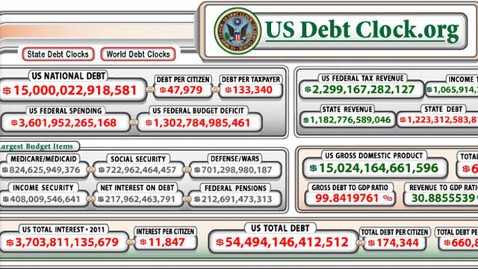
ht national debt clock wy 111116 wblog U.S. Debt Tops $15 Trillion Mark Today
(usdebtclock.org)

Don’t look now, members of the “supercommittee” battling the national debt, but the amount the U.S. owes topped the $15 trillion mark Wednesday afternoon.

That’s a lot of George Washingtons, as you can see here live at USdebtclock.org.

With a week until the committee’s deadline to reach agreement on cutting $1.2 trillion to $1.5 trillion from the federal deficit over the next 10 years, the Joint Select Committee on Deficit Reduction still has no agreement to stem automatic cuts to the budget.

A Democrat on a special deficit-cutting supercommittee Wednesday questioned whether Republicans are still interested in negotiating after the panel’s top GOP member said Republicans have “gone as far as we feel we can go” on tax hikes, the Associated Press reported.

A sense of deep pessimism has gripped the supercommittee, and judging from the limited public statement by panel members, a debt bargain could be out of reach.

“We need to find out whether our Republican colleagues want to continue to negotiate or whether they’ve drawn a hard line in the sand,” said supercommittee member Chris Van Hollen, a Democrat from Maryland. “The question is whether they’ve kind of said ‘take it or leave it.’ ”

The deficit has ballooned to nearly $48,000 for every man, woman and child in the U.S. This year alone, the U.S. will spend $1.3 trillion more than it takes in.

The debt has expanded at an alarming pace, from $7.5 trillion in 2004 and $5.6 trillion in 2000. At the current rate, Debtclock.org reckons that the debt will top $23 trillion in 2015, though the nonpartisan Congressional Budget Office puts the estimate at $17.6 trillion.

Back in August after a protracted fight, Congress voted to raised the national-debt ceiling by $2.7 trillion to $17 trillion, while requiring $2.7 trillion in deficit reduction by 2021.

Compared with other developed nations, the U.S. has a debt to GDP ratio of 85 percent, compared with Germany at 74 percent and Japan at a whopping 194 percent. World debt clocks can be found here.

Tuesday, October 25, 2011

Losing the Debt Battle

From: The Weekly Standard

On the issue of public debt, Washington is experiencing what psychologists call “learned helplessness.” The financial news is so relentlessly terrible that people have become numb to it and assume nothing can be done to regain control over our fate.

Today the world’s public and private debt exceeds an incredible 300 percent of GDP. We are at risk of succumbing to an ugly, downward, global mark-to-market in asset prices. Yet the discussion in Washington fails to reflect the immensity of the threat.

Some money managers have a theory that this mark-to-market process has been under way for some time. Stage One was the 1990s Asian crisis. Global financial markets concluded that Asia’s debt was dangerously high and its banks’ balance sheets not reflective of reality. Global traders pounced. Interest rates soared, equity markets plummeted, banks failed, and currencies collapsed.

Stage Two is happening in Europe today.

Stage Three will eventually hit the United States. Washington policy-makers seem confident America’s public debt risk is years away. They believe that the U.S. economy, with the dollar the reserve currency, enjoys some immunity from these concerns. The central bank, moreover, can buy bonds to keep interest rates from rising in response to growing debt. Yet these are risky assumptions.

A year ago, senior European officials never dreamed they’d be in their current mess. Greece represents only 3 percent of the Eurozone economy. Bailout tricks and clever central bank interventions were supposed to calm nervous markets. That happened, but didn’t last. A powerful global financial market brought officials to their knees. Today, many European policymakers can’t believe America is risking a similar outcome. True, as a means of protection the Fed itself will try to manipulate credit markets by keeping long-term interest rates artificially low. But global financial markets will simply penalize bank stocks, a phenomenon that may result in a credit contraction and double dip recession.

The larger danger is that ballooning debt reaches a tipping point beyond which financial markets conclude the debt cannot be repaid without instigating political chaos. That is Europe’s predicament today. Markets realize that the austerity policies needed to bring the debt under control are making the task of debt reduction impossible, as tax revenues plummet.

Some analysts, including Criton Zoakos, argue that the global economy has reached a “point of no return.” Debt suffocates growth, which destroys equity values (particularly financial stocks), which diminishes lending, investment, and consumption. Falling tax receipts lead to even more debt. Optimists argue not to worry. The world since January 2008, they say, has been undergoing an important period of public and private deleveraging. Growth will resume once deleveraging is completed.

If only life were that simple! Global indebtedness, according to Zoakos, has actually increased by 17 percent since the beginning of 2008. Nations have enacted generous bailout and stimulus programs while growth has averaged an anemic 1.2 percent.


With the world having fallen into a giant liquidity trap, monetary policy has been ineffective. Because of the growing slack in the economy as the developing world joins in the global slowdown, the central bankers couldn’t inflate their way out of today’s debt problem through bond purchases even if they wanted to.

Thursday, June 23, 2011

A Note To Congressional Republicans: Read Our Lips, No New Taxes

So, the political chattering class is aghast that Eric Cantor and Jon Kyl have walked out of the Biden negotiations on the debt ceiling. Unless this is posturing to us the conservative "wingnuts" they have done the right thing. It is at this time I want to remind everyone of a little history.

We all remember George H.W. Bush's "no new tax" pledge. We all remember him breaking the promise. Most objective observers on all sides concede his re election had he not broken that pledge. Why did he break it? Because of our debt and annual deficits. He was conned by the Democrats into believing they would cut spending if he agreed to the tax increases. He agreed and broke his pledge. The tax increases were on the front end of the five year budget he signed off on and the bulk of the proposed spending cuts were on the back end of the five year budget outlay.

The Democrats subsequent to this agreement used Bush's broken pledge to defeat him and elect Bill Clinton. They succeeded and then promptly reneged on the spending cuts. Game.Set.Match.SUCKER!!!!!!!!

The prospect of some kind of tax increase in any agreement has been looming for a while. Personally, I'm of the belief that every budget approved is littered however marginally with tax increases or fees so in the end most members have voted for increases even if nominal in size. The statement today by Max Baucus that there must be a one to one ratio on cuts and tax increases is blatantly political at the expense of potential fiscal insolvency. It's dramatically less than the unappealing "Deficit Commission" that proposed a 3-1 cut to increase ratio.
 
I am absolutely confident that Congressional Republicans will not vote for this absurd proposition. Boehner is correct that they don't have the votes. Even if I thought Boehner was sympathetic to the proposal it would be his end politically. Moreover, Democrats would do to any tax increasing Republicans what they did to Bush 41 and use it to defeat them in 2012 as a wedge to get back the majority. Does anyone think they would follow through on the promised spending cuts if they reemerged in the majority after running against pledge breaking Republicans? No cuts and more spending. One more giant step into oblivion.

The stakes are too high to get weak kneed in the wake of partisan Presidential politics. Obama is betting he get enough squishy Repubs who don't want to be blamed for a "default" will cave as the pressure mounts. Wait and see, but I've got a feeling they all know they're being played for sucker. Obama is playing with fire and we must keep our guys' feet to the fire. We can win this on the merits and achieve a public relations victory if we have the courage now as George Bush did not over twenty years ago. No new taxes.Not now.Not in a recession.Not when investors are afraid to invest.Not when the American people are willing to scale back Big Brother. To Congressional Republicans: Read our Lips, No New Taxes.

Obama, Congress warned: National debt growing faster

From: The Oval

The Congressional Budget Office reported Wednesday that the nation probably will owe outside creditors more than the size of the entire economy in 10 years.

The forecast -- a public debt equal to 101% of the economy in 2021, and rising to 187% by 2035 unless dramatic changes are made -- should be a warning to President Obama, Congress and Vice President Biden's band of bipartisan negotiators meeting daily to devise just a short-term fix.

By comparison, last year's long-term budget outlook from CBO forecast a public debt equal to 87% of the economy by 2020. The difference -- 14% -- would be about $2 trillion based on today's economy, even more as it grows.

"The explosive path of federal debt ... underscores the need for large and rapid policy changes to put the nation on a sustainable fiscal course," the report says.

It goes on: "Large budget deficits and growing debt would reduce national saving, leading to higher interest rates, more borrowing from abroad and less domestic investment, which in turn would lower income growth in the United States."

The problem outlined in the report: spending that far outpaces revenue as the years pass. Here's a simplified version:
  • Spending is projected to grow from 24% of the economy today to 26% in 2021 and 34% in 2035.
  • Revenue is projected to grow from 15% today to 19% in 2021, where it would remain in 2035.
  • Annual deficits would be 7.5% of the economy in 2021, less than today's 9.3%. But each year's deficit adds to the national debt. By 2035, the deficit would be 15.5% of the economy, and the accumulated debt would be 187%.
Sen. Kent Conrad, chairman of the Senate Budget Committee, said the report should prompt negotiators seeking ways to raise the nation's debt limit to think big.

"CBO's new long-term budget outlook again highlights the urgency of reaching agreement on a bipartisan and comprehensive long-term deficit and debt reduction plan," he said. "We must address the projected explosion in federal debt. If we fail to act, it will have devastating consequences for our economy and for the future well-being of the American people."

Rep. Paul Ryan, chairman of the House Budget Committee and author of a controversial plan to cut $4.4 trillion from annual deficits over 10 years, noted CBO warned of a credit crisis unless changes are made:
Today the CBO reiterated what the American people know, but too many in Washington simply refuse to acknowledge: We are headed for the most predictable economic crisis in American history, and Washington is not providing the leadership we need to avoid it. As Congress debates the president's request for an increase in the statutory debt ceiling, the CBO warns of a more ominous credit cliff -- a sudden drop-off in our ability to borrow imposed by credit markets in a state of panic.

Thursday, May 05, 2011

National Debt: Fix It or Face National Decline

FROM: The Fiscal Times

In spite of the jubilation over the demise of mass murderer Osama bin Laden there is a demoralized public sense that our government is in disarray and unable to make the wise and tough decisions to get things done to solve the problems of the nation, including our national debt. They seem not to have the capacity to build a consensus for constructive compromise, which is critical to solving our problems. We need someone who fits Harry Truman’s definition of a leader: a man who has the ability to get other people to do what they don’t want to do and to like it.

The talk today is about decline and recession and a faltering America that no longer leads the world. No longer do we have the air of what Mark Twain once described as, “the serene confidence of a poker player with four aces.”

We worry that our children will not enjoy the opportunities we so long took for granted. We worry that our financial system is broken and is still not fixed. We worry that our healthcare problems are not solved. We worry about our fiscal problems, in the face of trillion dollar plus deficits as far as the eye can see. Who would have ever imagined that the credit rating of the United States would be put on financial watch by Standard & Poor’s?

Who would have imagined the largest fixed-income financial firm, PIMCO would have stated they have not only sold all their treasury paper but are selling American bonds short because they do not have faith that our political leadership can deal with the fiscal crisis?

Congressmen spend more of their time raising money
for misleading and defamatory TV commercials than
they spend settling our predicaments.
 
There is a sigh of “too true” in Mancur Olson’s contention in his book, The Rise and Decline of Nations, in which he decries the creation of a culture of entitlement, where special interest groups take bite after tiny bite out of the total national wealth through tax breaks, lobbying for special appropriations, earmarks, and other favors that are all easier to initiate than to end, thus undermining the will and moral authority to govern on the basis of the country’s long-term interests rather than the short-term political interests of our representatives.

Tuesday, April 26, 2011

S&P Is Too Optimistic

From: Asia Times Online

The good news from Standard & Poor's was that the company reaffirmed the United States' "AAA" sovereign debt rating. The bad news was that its outlook was revised to "negative".

From Standard & Poor's: "We believe there is a material risk that US policymakers might not reach an agreement on how to address medium- and long-term budgetary challenges by 2013; if an agreement is not reached and meaningful implementation does not begin by then, this would in our view render the US fiscal profile meaningfully weaker than that of peer 'AAA' sovereigns."

US bond prices actually moved up on the news (in the face of last Monday's weak stock market), and yields ended lower for the week. It's true that the markets were not caught unaware of our nation's fiscal woes. And similar to other potentially negative fundamental developments, markets participants are these days content to play the here and now - and leave structural issues for some later date.

From my perspective, S&P's summary point for why the US retains its top rating provided the most contestable aspect of their report: "The economy of the US is flexible and highly diversified, the country's effective monetary policies have supported output growth while containing inflationary pressures, and a consistent global preference for the US dollar over all other currencies gives the country unique external liquidity."

Clearly, our "flexible and highly diversified" economy was unsuccessful in thwarting a crisis of confidence for much of our private sector debt - a debacle that nearly led to the collapse of our credit system, stock market and economy back in 2008. And having witnessed our monetary policy propagate a 20-year cycle of booms and busts, I'll stick to the view that the Federal Reserve is more of a liability than an asset when it comes to prospective debt quality.

Loose monetary policy from the Fed accommodated the greatest expansion in mortgage debt in history - and now zero rates and monetization are well on their way to supporting a historic boom in government debt. And, of course, a decade of dollar weakness raises the question as to the true underlying "global preference" for our currency.

There's going to be one hell of fight in Washington over the details of deficit reduction. With too many eyes on 2012 elections, it's sure to be a challenging environment - to say the least - to muster bi-partisan compromise. Prospects for any serious near-term spending cuts are slim to none - and the markets are more than fine with this. The marketplace believes it has at least a couple additional years before the debt situation turns problematic (hence, market-impactful). In the meantime, participants are confident that the odds of big - and destabilizing - spending cuts prior to 2013 are slim. This is all in the market.

Inflation? Michael Kinsley Thinks It's Coming

This from the guy who was routinely handed his head on "Crossfire" by Pat Buchanan and John Sununu back when CNN was in its salad days.

From: The Los Angeles Times

Standard & Poor's, the bond rating service, has been widely mocked for its recent prediction that the U.S. government may default on its bonds. It's a highly qualified prediction, sort of a prediction of a prediction of a remote possibility. S&P estimates there's a 1-in-3 chance that it will downgrade its ratings of U.S. bonds. So the chance of a default has increased from unimaginable to almost unimaginable. But, like that kid in math class who bursts into tears when the test comes back graded A-, America would find this traumatizing because it's never happened before.

Some people say, relax and don't worry about it.

They argue first: Standard & Poor's is dealing, in this case, with public information. It knows nothing that you don't know, or could not find out, about United States government bonds. These aren't remarkable investment opportunities involving Nigerian royalty, like the ones offered in my email inbox every day. They are backed by the full faith and credit of the United States.

Besides, the folks at Standard & Poor's are just overcompensating for burying their heads in the sand during the subprime mortgage collapse.

What's more, the United States government will never default on its debts, because (unlike almost every other debtor in the world, including other sovereign nations) the United States can just print more money. "At least one economist" (i.e., one economist) is widely cited in the blogosphere as issuing a "derisive guffaw" at the notion that the United States can ever default on its obligations as long as there's still fuel to run the printing presses.

Well, I don't know. Standard & Poor's may know nothing that I couldn't find out, but it certainly knows more than I've bothered to find out. (And how about you?) And how its experts assess all this publicly available information is surely worth knowing, isn't it?

Second: Yes, the bond rating agencies failed to warn investors about the home mortgage debacle. What are they supposed to do now? Just go out of business?

Monday, April 25, 2011

Doomsday on debt?

From: NYPOST.com

Some of the best minds on Wall Street are obsessing about the theoretical chance that the country might default on its debt if Congress and the president somehow fail to reach an agreement and raise the so-called debt ceiling.

Now, there's plenty to worry about when it comes to the economy -- from rising gas prices and the threat of inflation to the ever-looming possibility that the anemic recovery might peter out.

Make no mistake, default would be terrible. It wouldn't just make us a basket case like Greece or Portugal; it would probably lead to a global financial collapse that would make the 2008 crisis seem trivial.

But no serious politician in either party is talking about letting the country default on its debt -- even if they don't reach an agreement on raising the debt ceiling by mid-May, when our borrowing will hit the current limit.

Maxed Out America: Coming Sooner Than You Think

From: Pajamas Media

Washington’s recent budget deal represents at best a tiny baby step in the right direction. What is at stake in the budget battles to come is exponentially higher. This is why the “Maxed Out America” initiative of the PJ Institute demands the immediate attention of the political class and the American people.

Everyone knows that an individual or family can only afford to go so far into debt before they become “maxed out.” At that point, lenders charge higher interest rates, refuse to extend additional credit, and cut existing credit lines.

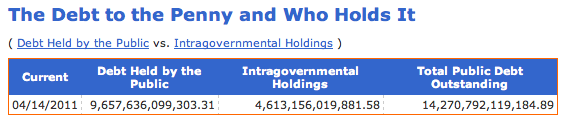
The idea that there are limits on borrowing applies equally to the federal government, but its determination and ability to avoid grim reality have been much greater. For decades, Beltway politicians, with recent assistance from the Federal Reserve, have used tools not available to individuals and families to push off the government’s reckoning date. As of April 14, they have run up the nation’s “debt held by the public” — really amounts owed to individuals, corporations, and other countries — to over $9.6 trillion, an amount that is roughly 65% of the nation’s annual output, or Gross Domestic Product (GDP).

How far can a government run up its debts before lenders either decide to stop lending or raise their interest rates? As PJ Institute economist Laurence Kotlikoff noted in an early April column, there is a consensus that a country reaches “a critical insolvency threshold” once its public debt hits 90% of GDP. At that point, lender cutoffs and interest-rate premiums become real possibilities. Call it the point where we become “Maxed Out America.”

China Proposes To Cut Two Thirds Of Its $3 Trillion In USD Holdings

From: Zero Hedge.com

All those who were hoping global stock markets would surge tomorrow based on a ridiculous rumor that China would revalue the CNY by 10% will have to wait. Instead, China has decided to serve the world another surprise. Following last week's announcement by PBoC Governor Zhou (Where's Waldo) Xiaochuan that the country's excessive stockpile of USD reserves has to be urgently diversified, today we get a sense of just how big the upcoming Chinese defection from the "buy US debt" Nash equilibrium will be. Not surprisingly, China appears to be getting ready to cut its USD reserves by roughly the amount of dollars that was recently printed by the Fed, or $2 trilion or so. And to think that this comes just as news that the Japanese pension fund will soon be dumping who knows what. So, once again, how about that "end of QE" again?


From Xinhua:
China's foreign exchange reserves increased by 197.4 billion U.S. dollars in the first three months of this year to 3.04 trillion U.S. dollars by the end of March.

Xia Bin, a member of the monetary policy committee of the central bank, said on Tuesday that 1 trillion U.S. dollars would be sufficient. He added that China should invest its foreign exchange reserves more strategically, using them to acquire resources and technology needed for the real economy.
And as if the public sector making it all too clear what is about to happen was not enough, here is the private one as well:

Monday, April 18, 2011

Stocks plunge after S&P shifts rating on US debt to negative

From: The Hill

Standard & Poor’s Ratings Services announced Monday it was lowering its outlook on U.S. debt from “stable” to “negative.”

Markets immediately fell on the news, with the Dow Jones Industrial Average dropping 214 points or 1.74 percent, as of 1 p.m.

Republicans cast the report as a wake-up call underlining their arguments that the administration should accept significant spending cuts in exchange for raising the nation's debt ceiling, while the White House said it underscored the need for a bipartisan deal.

“Today’s announcement makes clear that the debt limit increase proposed by the Obama Administration must be accompanied by meaningful fiscal reforms that immediately reduce federal spending and stop our nation from digging itself further into debt,” House Majority Leader Eric Cantor (R-Va.) said in a statement.

Administration officials downplayed the report and said S&P was underestimating the ability of Congress and the White House to reach a deal.

White House press secretary Jay Carney predicted the “political process will outperform S&P expectations.”

“We think a reminder that we need an agreement on fiscal reform is always valuable,” he added at the White House press briefing.

Separately, House Democrats seized on the report as an argument that the GOP should allow a “clean” vote on a measure to raise the nation’s $14.3 trillion debt ceiling. Republicans have been demanding spending concessions from the administration in exchange for raising the debt ceiling.

House Minority Leader Nancy Pelosi (D-Calif.) said the S&P report highlights the need to participate in debt talks to begin next month under the leadership of Vice President Joe Biden. She pointed out in a release that she has named Reps. Jim Clyburn (D-S.C.) and Chris Van Hollen (D-Md.) to the Biden talks. The GOP has yet to name participants.

President Obama and Republicans for the last week have exchanged shots over the deficit, and some Republicans argued the president’s harsh criticism of the House GOP budget would make it tougher to reach an agreement.

Saturday, April 09, 2011

The GOP did just fine

From: American Thinker

There is more good in the budget deal than is revealed in the budget cut number agreed on last night. Measured against the size of budget cutting necessary for the future, the numbers are small, to be sure, but this number was a tactical, not a strategic engagement. The key to the matter is momentum, principle, and precedent, which set up the strategic environment for 2012.


Andrew Stiles at NRO correctly points out the extent of the Harry Reid cave-in.

Senate Majority Leader Harry Reid (D., Nev.) didn't want to cut anything at first. But bowing to political reality, eventually ponied up about $4.7 billion in cuts. He ended up with $33.8 billion less spending than he wanted. And he called it an "historic" accomplishment. (Not surprisingly, the left is appalled).

House Speaker John Boehner (R., Ohio), on the other hand, initially proposed $32 billion in spending cuts. House Republicans, led by an undaunted freshman class, bumped that number up to $61 billion ($100 billion off the president's budget), before settling on $38.5 billion.

That's $6.5 billion more than Boehner asked for to begin with, and $5.5 billion more than the $33 billion that Vice President Joe Biden and Senate Democrats claimed had been agreed to less than two weeks ago.

The GOP Made a Bad Deal

From: American Thinker

Last night's budget compromise amounted to series of broken promises by the GOP, and it was a tremendous opportunity lost.  No matter what the accounting tricks and PR machinations say, the simple facts are that the GOP promised conservatives $100 billion in cuts, and didn't deliver.  Worse yet, the GOP misread its mandate for massive spending reform, and will suffer for it to the benefit of Democrats.  Here's why:

1.                  There's too much at stake.

This was last week's talking point -- one the GOP may have relinquished last night -- but it's impossible to underestimate the threat that that spending presents.   Blogger Ace of Spades captured things nicely in writing that even Rep. Ryan's proposed budget cuts are necessary, but hardly sufficient.

"If you believe that the GDP will start growing at a healthy rate and continue at that rate forever, and if you manage to reform Medicare, Medicaid, and Social Security, and if you reform the budget process, and if you reform the tax code, and if you accomplish all these reforms in FY12, then you might be able to pay off this year's spending within 11 to 12 years. Or maybe the decade after.  This is what the President and his crackerjack economic team have wrought. A one-year deficit that is so large that it can only be paid back if everything goes exactly right."

In the broader "spending-us-into-oblivion" context, last night's compromise struck exactly the wrong note.  Forget "runaway spending."   Ever seen Unstoppable?

Wednesday, March 30, 2011

Bankrupt: Entitlements and the Federal Budget

From: Cato Institute

The U.S. government is about to exceed its statutory debt limit of $14.3 trillion. But that actually underestimates the size of the fiscal time bomb that this country is facing. If one considers the unfunded liabilities of programs such as Medicare and Social Security, the true national debt could run as high as $119.5 trillion.

Tuesday, March 22, 2011

US Approaching Insolvency, Fix To Be 'Painful'

From: CNBC

The United States is on a fiscal path towards insolvency and policymakers are at a "tipping point," a Federal Reserve official said on Tuesday.

The President of the Federal Bank of Dallas, Richard W. Fisher

"If we continue down on the path on which the fiscal authorities put us, we will become insolvent, the question is when," Dallas Federal Reserve Bank President Richard Fisher said in a question and answer session after delivering a speech at the University of Frankfurt. "The short-term negotiations are very important, I look at this as a tipping point."

But he added he was confident in the Americans' ability to take the right decisions and said the country would avoid insolvency.

"I think we are at the beginning of the process and it's going to be very painful," he added.

Fisher earlier said the US economic recovery is gathering momentum, adding that he personally was extremely vigilant on inflation pressures.

"We are all mindful of this phenomenon. Speaking personally, I am concerned and I am going to be extremely vigilant on that front," Fisher said in an interview with CNBC.

Fisher added that the U.S. Federal Reserve had ways to tighten its monetary policy other than interest rates, including by selling Treasurys, changing reserves levels and using time deposits.

He added that he does not support the Fed embarking on an additional round of quantitative easing.

"Barring some extraordinary circumstance I cannot forsee...I would vote against a QE3," Fisher told CNBC. "I don't think it's necessary. Again, we have a self-sustaining recovery."

Related Posts Plugin for WordPress, Blogger...

FARK IT