Showing posts with label Eric Holder. Show all posts
Showing posts with label Eric Holder. Show all posts
Thursday, June 06, 2013


Monday, May 20, 2013
Thursday, March 07, 2013
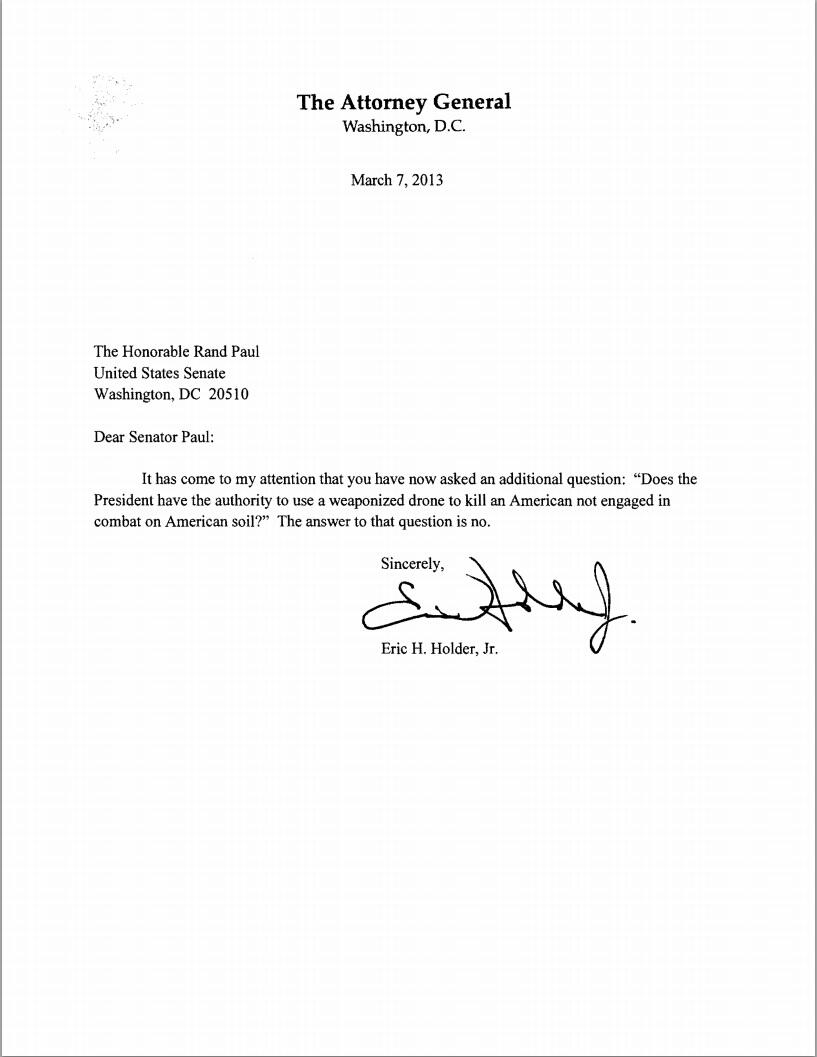
Holder's Letter to Rand Paul: 'No,' the U.S. Can't Use Drone to Kill Citizen Not Engaged in Combat on U.S. Soil
From: The Weekly Standard
Eric Holder responds to Rand Paul's filibuster with this letter:
UPDATE: Apparently, the White House and Justice Department failed to send the letter to the person who asked the question--Rand Paul.
Dear Senator Paul:Here's an image of that letter:
It has come to my attention that you have now asked an additional question: "Does the President have the authority to use a weaponized drone to kill an American not engaged in combat on American soil?" The answer to that question is no.
Sincerely,
Eric Holder
UPDATE: Apparently, the White House and Justice Department failed to send the letter to the person who asked the question--Rand Paul.
Monday, July 02, 2012
Obama Contributor, Who Helped Enact Assault-Weapons Ban, Ran ‘Fast and Furious
From: CNSNews.com
Dennis K. Burke, who as a lawyer for the Democrats on the Senate Judiciary Committee in the 1990s was a key player behind the enactment of the 1994 assault-weapons ban, and who then went on to become Arizona Gov. Janet Napolitano’s chief of staff, and a contributor to Barack Obama’s 2008 presidential primary campaign, and then a member of Obama's transition team focusing on border-enforcement issues, ended up in the Obama administration as the U.S. attorney in Arizona responsible for overseeing Operation Fast and Furious.
When Obama nominated Burke to be U.S. Attorney for the District of Arizona, Burke told the Arizona Capitol Times he believed he understood what the president and his attorney general wanted him to do.
“There’s clearly been direction provided already by President Obama and Attorney General Holder as to what they want to be doing, and this is an office that is at the center of the issues of border enforcement,” said Burke.
Over the course of several days, CNSNews.com left multiple telephone messages with Burke for comment on this story. He did not respond.
Dennis K. Burke has had a long career working as an aide and political appointee to Democratic elected officials. From 1989 to 1994, he was a counsel for the Democrats on the Senate Judiciary Committee, working in that capacity for several years on an assault-weapons ban, which was finally enacted on Sept. 13, 1994 as the Violent Crime Control and Law Enforcement Act. That act expired on Sept. 13, 2004. (See NYT: Dennis Burke, Sen. DeConcini, Weapons Ban.pdf)
From 1994-95, Burke served in the Clinton Justice Department in the Office of Legislative Affairs, and in 1997-99, he was an assistant U.S. attorney in Arizona.
From 1999 to 2003, Burke was chief deputy and special assistant to Arizona Attorney General Janet Napolitano.
In 2003, when Napolitano became governor, Burke became her chief of staff. He stayed in that job until the fall of 2008, when he left to help Democratic political campaigns, including then-Sen. Obama’s presidential campaign.
Federal Election Commission (FEC) records show that on Jan. 9, 2008, while working as Gov. Napolitano’s chief of staff, Burke contributed $2,000 to then-Sen Obama’s presidential primary campaign. Since 1997, according to FEC records, Burke has contributed a total of $16,350 to various Democratic candidates.
After Obama was elected in November 2008, Burke joined his presidential transition team, serving on the Immigration Policy Working Group.
Eight days before Obama’s inauguration, on Jan. 12, 2009--while Burke was working on the transition team--Obama met with Mexican President Felipe Calderon at the Mexican Cultural Institute in Washington, D.C. At that meeting, Obama “pledged” to take action to stop the flow of guns from the United States to Mexico.
Obama also decided to put Burke’s old boss, incoming Homeland Security Secretary Janet Napolitano, in a leadership role in making the gun-trafficking problem a top priority.
“President-elect Obama expressed support for efforts in the border states in both the United States and Mexico to eradicate drug-related violence and stop the flow of guns and cash,” incoming White House Press Secretary Robert Gibbs said in a statement at the time. “He told President Calderón that he intends to ask the Secretary of Homeland Security to lead an effort to increase information sharing to strengthen those efforts. He pledged to take more effective action from the United States to stem the flow of arms from the United States to Mexico.”
When Napolitano became Homeland Security secretary, Burke moved from the Obama transition team to become her senior adviser. On Feb. 25, 2009, a little more than a month after Obama had made his “pledge” to Calderon, Napolitano testified in the House Homeland Security Committee. She stressed that stopping the flow of guns to Mexico was a top priority of the Obama administration and key focus of her work.
Responding to a question about violence on the border, Napolitano said the administration was going to work with the Mexican government on the issue. Then she said: “Secondly, it is looking at, government-wide, at what we can do to stop the southbound export of weaponry, particularly assault-type weapons and grenades that are being used in that drug war.”
Napolitano further noted that drug cartels were targeting Mexican government officials and law enforcement officers, and that, given the seriousness of the threat, Obama’s national security adviser, the attorney general, the Bureau of Alcohol, Tobacco, Firearms and Explosives (ATF), and Customs (of which the Border Patrol is part) would all be working on the issue.
Dennis K. Burke, who as a lawyer for the Democrats on the Senate Judiciary Committee in the 1990s was a key player behind the enactment of the 1994 assault-weapons ban, and who then went on to become Arizona Gov. Janet Napolitano’s chief of staff, and a contributor to Barack Obama’s 2008 presidential primary campaign, and then a member of Obama's transition team focusing on border-enforcement issues, ended up in the Obama administration as the U.S. attorney in Arizona responsible for overseeing Operation Fast and Furious.
When Obama nominated Burke to be U.S. Attorney for the District of Arizona, Burke told the Arizona Capitol Times he believed he understood what the president and his attorney general wanted him to do.
“There’s clearly been direction provided already by President Obama and Attorney General Holder as to what they want to be doing, and this is an office that is at the center of the issues of border enforcement,” said Burke.
Over the course of several days, CNSNews.com left multiple telephone messages with Burke for comment on this story. He did not respond.
Dennis K. Burke has had a long career working as an aide and political appointee to Democratic elected officials. From 1989 to 1994, he was a counsel for the Democrats on the Senate Judiciary Committee, working in that capacity for several years on an assault-weapons ban, which was finally enacted on Sept. 13, 1994 as the Violent Crime Control and Law Enforcement Act. That act expired on Sept. 13, 2004. (See NYT: Dennis Burke, Sen. DeConcini, Weapons Ban.pdf)
From 1994-95, Burke served in the Clinton Justice Department in the Office of Legislative Affairs, and in 1997-99, he was an assistant U.S. attorney in Arizona.
From 1999 to 2003, Burke was chief deputy and special assistant to Arizona Attorney General Janet Napolitano.
In 2003, when Napolitano became governor, Burke became her chief of staff. He stayed in that job until the fall of 2008, when he left to help Democratic political campaigns, including then-Sen. Obama’s presidential campaign.
Federal Election Commission (FEC) records show that on Jan. 9, 2008, while working as Gov. Napolitano’s chief of staff, Burke contributed $2,000 to then-Sen Obama’s presidential primary campaign. Since 1997, according to FEC records, Burke has contributed a total of $16,350 to various Democratic candidates.
After Obama was elected in November 2008, Burke joined his presidential transition team, serving on the Immigration Policy Working Group.
Eight days before Obama’s inauguration, on Jan. 12, 2009--while Burke was working on the transition team--Obama met with Mexican President Felipe Calderon at the Mexican Cultural Institute in Washington, D.C. At that meeting, Obama “pledged” to take action to stop the flow of guns from the United States to Mexico.
Obama also decided to put Burke’s old boss, incoming Homeland Security Secretary Janet Napolitano, in a leadership role in making the gun-trafficking problem a top priority.
“President-elect Obama expressed support for efforts in the border states in both the United States and Mexico to eradicate drug-related violence and stop the flow of guns and cash,” incoming White House Press Secretary Robert Gibbs said in a statement at the time. “He told President Calderón that he intends to ask the Secretary of Homeland Security to lead an effort to increase information sharing to strengthen those efforts. He pledged to take more effective action from the United States to stem the flow of arms from the United States to Mexico.”
When Napolitano became Homeland Security secretary, Burke moved from the Obama transition team to become her senior adviser. On Feb. 25, 2009, a little more than a month after Obama had made his “pledge” to Calderon, Napolitano testified in the House Homeland Security Committee. She stressed that stopping the flow of guns to Mexico was a top priority of the Obama administration and key focus of her work.
Napolitano further noted that drug cartels were targeting Mexican government officials and law enforcement officers, and that, given the seriousness of the threat, Obama’s national security adviser, the attorney general, the Bureau of Alcohol, Tobacco, Firearms and Explosives (ATF), and Customs (of which the Border Patrol is part) would all be working on the issue.
Thursday, June 28, 2012
Wednesday, June 27, 2012
Eric Holder Won't Turn "Holy Land Foundation" Docs
From: Family Security Matters
U.S. Attorney General Eric Holder is in the spotlight after the House Oversight and Government Reform Committee voted to hold him in contempt because he is refusing to provide documents related to the Fast and the Furious scandal. But there's another scandal you should know about. For over one year, he has refused to hand over documents about the Muslim Brotherhood network in the U.S.
Rep. Louie Gohmert (R-TX), vice chairman of the House Judiciary Committee's Subcommittee on Crime, Terrorism and Homeland Security, confronted Holder about the matter on Thursday, June 21. Rep. Gohmert wants Congress to have access to documents from the trial of the Holy Land Foundation, the largest terrorism financing trial in U.S. history. Five Foundation officials were found guilty of funding Hamas and evidence introduced by the federal government shows it was set up by the Muslim Brotherhood's secret "Palestine Committee" in the U.S.
Thursday, June 21, 2012
CBS REPORTS!!!: ATF used "Fast and Furious" to make the case for gun regulations
FROM: CBS NEWS
Documents obtained by CBS News show that the Bureau of Alcohol Tobacco, Firearms and Explosives (ATF) discussed using their covert operation "Fast and Furious" to argue for controversial new rules about gun sales.
In Fast and Furious, ATF secretly encouraged gun dealers to sell to suspected traffickers for Mexican drug cartels to go after the "big fish." But ATF whistleblowers told CBS News and Congress it was a dangerous practice called "gunwalking," and it put thousands of weapons on the street. Many were used in violent crimes in Mexico. Two were found at the murder scene of a U.S. Border Patrol agent.
ATF officials didn't intend to publicly disclose their own role in letting Mexican cartels obtain the weapons, but emails show they discussed using the sales, including sales encouraged by ATF, to justify a new gun regulation called "Demand Letter 3". That would require some U.S. gun shops to report the sale of multiple rifles or "long guns." Demand Letter 3 was so named because it would be the third ATF program demanding gun dealers report tracing information.
On July 14, 2010 after ATF headquarters in Washington D.C. received an update on Fast and Furious, ATF Field Ops Assistant Director Mark Chait emailed Bill Newell, ATF's Phoenix Special Agent in Charge of Fast and Furious:
"Bill - can you see if these guns were all purchased from the same (licensed gun dealer) and at one time. We are looking at anecdotal cases to support a demand letter on long gun multiple sales. Thanks."
On Jan. 4, 2011, as ATF prepared a press conference to announce arrests in Fast and Furious, Newell saw it as "(A)nother time to address Multiple Sale on Long Guns issue." And a day after the press conference, Chait emailed Newell: "Bill--well done yesterday... (I)n light of our request for Demand letter 3, this case could be a strong supporting factor if we can determine how many multiple sales of long guns occurred during the course of this case."
This revelation angers gun rights advocates. Larry Keane, a spokesman for National Shooting Sports Foundation, a gun industry trade group, calls the discussion of Fast and Furious to argue for Demand Letter 3 "disappointing and ironic." Keane says it's "deeply troubling" if sales made by gun dealers "voluntarily cooperating with ATF's flawed 'Operation Fast & Furious' were going to be used by some individuals within ATF to justify imposing a multiple sales reporting requirement for rifles."
The Gun Dealers' Quandary
Several gun dealers who cooperated with ATF told CBS News and Congressional investigators they only went through with suspicious sales because ATF asked them to.
Sometimes it was against the gun dealer's own best judgment.
Read the email
In April, 2010 a licensed gun dealer cooperating with ATF was increasingly concerned about selling so many guns. "We just want to make sure we are cooperating with ATF and that we are not viewed as selling to the bad guys," writes the gun dealer to ATF Phoenix officials, "(W)e were hoping to put together something like a letter of understanding to alleviate concerns of some type of recourse against us down the road for selling these items."
Read the email
ATF's group supervisor on Fast and Furious David Voth assures the gun dealer there's nothing to worry about. "We (ATF) are continually monitoring these suspects using a variety of investigative techniques which I cannot go into detail."
Two months later, the same gun dealer grew more agitated.
"I wanted to make sure that none of the firearms that were sold per our conversation with you and various ATF agents could or would ever end up south of the border or in the hands of the bad guys. I guess I am looking for a bit of reassurance that the guns are not getting south or in the wrong hands...I want to help ATF with its investigation but not at the risk of agents (sic) safety because I have some very close friends that are US Border Patrol agents in southern AZ as well as my concern for all the agents (sic) safety that protect our country."
"It's like ATF created or added to the problem so they could be the solution to it and pat themselves on the back," says one law enforcement source familiar with the facts. "It's a circular way of thinking."
The Justice Department and ATF declined to comment. ATF officials mentioned in this report did not respond to requests from CBS News to speak with them.
The "Demand Letter 3" Debate
The two sides in the gun debate have long clashed over whether gun dealers should have to report multiple rifle sales. On one side, ATF officials argue that a large number of semi-automatic, high-caliber rifles from the U.S. are being used by violent cartels in Mexico. They believe more reporting requirements would help ATF crack down. On the other side, gun rights advocates say that's unconstitutional, and would not make a difference in Mexican cartel crimes.
Two earlier Demand Letters were initiated in 2000 and affected a relatively small number of gun shops. Demand Letter 3 was to be much more sweeping, affecting 8,500 firearms dealers in four southwest border states: Arizona, California, New Mexico and Texas. ATF chose those states because they "have a significant number of crime guns traced back to them from Mexico." The reporting requirements were to apply if a gun dealer sells two or more long guns to a single person within five business days, and only if the guns are semi-automatic, greater than .22 caliber and can be fitted with a detachable magazine.
On April 25, 2011, ATF announced plans to implement Demand Letter 3. The National Shooting Sports Foundation is suing the ATF to stop the new rules. It calls the regulation an illegal attempt to enforce a law Congress never passed. ATF counters that it has reasonably targeted guns used most often to "commit violent crimes in Mexico, especially by drug gangs."
Reaction
Sen. Charles Grassley, R-Iowa, is investigating Fast and Furious, as well as the alleged use of the case to advance gun regulations. "There's plenty of evidence showing that this administration planned to use the tragedies of Fast and Furious as rationale to further their goals of a long gun reporting requirement. But, we've learned from our investigation that reporting multiple long gun sales would do nothing to stop the flow of firearms to known straw purchasers because many Federal Firearms Dealers are already voluntarily reporting suspicious transactions. It's pretty clear that the problem isn't lack of burdensome reporting requirements."
On July 12, 2011, Sen. Grassley and Rep. Darrell Issa, R-Calif., wrote Attorney General Eric Holder, whose Justice Department oversees ATF. They asked Holder whether officials in his agency discussed how "Fast and Furious could be used to justify additional regulatory authorities." So far, they have not received a response. CBS News asked the Justice Department for comment and context on ATF emails about Fast and Furious and Demand Letter 3, but officials declined to speak with us.
"In light of the evidence, the Justice Department's refusal to answer questions about the role Operation Fast and Furious was supposed to play in advancing new firearms regulations is simply unacceptable," Rep. Issa told CBS News.
Wednesday, June 13, 2012
Thursday, June 07, 2012
Holder Claims Emails Using Words ‘Fast and Furious’ Don’t Refer to Operation Fast and Furious
From: CNSNews.com
Attorney General Eric Holder claimed during congressional testimony today that internal Justice Department emails that use the phrase “Fast and Furious” do not refer to the controversial gun-walking operation Fast and Furious.
Under questioning from Rep. Jason Chaffetz (R-Utah), who read excerpts of the emails at a House Judiciary Committee hearing on Justice Department oversight, Holder claimed that the phrase “Fast and Furious” did not refer to Fast and Furious but instead referred to another gun-walking operation known as “Wide Receiver.”
However, the emails refer to both programs -- "Fast and Furious" and the "Tucson case," from where Wide Receiver was launched -- and reveal Justice Department officials discussing how to handle media scrutiny when both operations become public.
Among three of the emails (see Jason Weinstein Email Fast, Furious.pdf), the second, dated “October 17, 2010 11:07 PM,” was sent by Deputy Assistant Attorney General Jason Weinstein to James Trusty and it states: “Do you think we should have Lanny participate in press when Fast and Furious and Laura’s Tucson case [Wide Receiver] are unsealed? It’s a tricky case, given the number of guns that have walked, but it is a significant set of prosecutions.”
“It’s not clear how much we’re involved in the main F and F [Fast and Furious] case,” reads the email, “but we have Tucson [Wide Receiver] and now a new unrelated case with [redacted] targets. It’s not any big surprise that a bunch of US guns are being used in MX [Mexico], so I’m not sure how much grief we get for ‘guns walking.’ It may be more like ‘Finally, they’re going after people who sent guns down there.’”
Operation Wide Receiver was run out of Tucson, Ariz., between 2006 and 2007 by the Bureau of Alcohol, Tobacco, Firearms, and Explosives (ATF), a division of the Justice Department.
In his testimony, Holder said that the emails only referred to Operation Wide Receiver.
Holder told the committee: “That refers to Wide Receiver, not to Fast and Furious. The e-mail that you [Rep. Chaffetz] just read [between Trusty and Weinstein] – now this is important – that email referred to Wide Receiver, it did not refer to Fast and Furious. That has to be noted for the record.”
Chaffetz, after a long pause, said, "No, it doesn't. It says Fast and Furious. 'Do you think we should have Lanny participate in press when Fast and Furious and Laura’s Tucson case [Wide Receiver] are unsealed?' It's specific to Fast and Furious. That is not true, Mr. Attorney General. I'm happy to share it with you."
Operation Fast and Furious was carried out by the ATF. It began in the fall of 2009 and continued into early 2011, during which time the federal government purposefully allowed known or suspected gun smugglers to purchase guns at federally licensed firearms dealers in Arizona. The government did not seek to abort these gun purchases, intercept the smugglers after the purchases, or recover the guns they had purchased.
In some cases, as the government expected they would, the smugglers delivered the guns to Mexican drug trafficking organizations. Two rifles sold to a smuggler in the course of Operation Fast and Furious in January 2010 ended up at the scene of the murder of U.S. Border Patrol Agent Brian Terry in December 2010.
Attorney General Eric Holder claimed during congressional testimony today that internal Justice Department emails that use the phrase “Fast and Furious” do not refer to the controversial gun-walking operation Fast and Furious.
Under questioning from Rep. Jason Chaffetz (R-Utah), who read excerpts of the emails at a House Judiciary Committee hearing on Justice Department oversight, Holder claimed that the phrase “Fast and Furious” did not refer to Fast and Furious but instead referred to another gun-walking operation known as “Wide Receiver.”
However, the emails refer to both programs -- "Fast and Furious" and the "Tucson case," from where Wide Receiver was launched -- and reveal Justice Department officials discussing how to handle media scrutiny when both operations become public.
Among three of the emails (see Jason Weinstein Email Fast, Furious.pdf), the second, dated “October 17, 2010 11:07 PM,” was sent by Deputy Assistant Attorney General Jason Weinstein to James Trusty and it states: “Do you think we should have Lanny participate in press when Fast and Furious and Laura’s Tucson case [Wide Receiver] are unsealed? It’s a tricky case, given the number of guns that have walked, but it is a significant set of prosecutions.”
In the third email, dated Oct. 18, 2010, James Trusty writes back to Weinstein: “I think so, but the timing will be tricky, too. Looks like we’ll be able to unseal the Tucson case sooner than the Fast and Furious (although this may be just the difference between Nov. and Dec).”
“It’s not clear how much we’re involved in the main F and F [Fast and Furious] case,” reads the email, “but we have Tucson [Wide Receiver] and now a new unrelated case with [redacted] targets. It’s not any big surprise that a bunch of US guns are being used in MX [Mexico], so I’m not sure how much grief we get for ‘guns walking.’ It may be more like ‘Finally, they’re going after people who sent guns down there.’”
Operation Wide Receiver was run out of Tucson, Ariz., between 2006 and 2007 by the Bureau of Alcohol, Tobacco, Firearms, and Explosives (ATF), a division of the Justice Department.
In his testimony, Holder said that the emails only referred to Operation Wide Receiver.
Holder told the committee: “That refers to Wide Receiver, not to Fast and Furious. The e-mail that you [Rep. Chaffetz] just read [between Trusty and Weinstein] – now this is important – that email referred to Wide Receiver, it did not refer to Fast and Furious. That has to be noted for the record.”
Chaffetz, after a long pause, said, "No, it doesn't. It says Fast and Furious. 'Do you think we should have Lanny participate in press when Fast and Furious and Laura’s Tucson case [Wide Receiver] are unsealed?' It's specific to Fast and Furious. That is not true, Mr. Attorney General. I'm happy to share it with you."
In some cases, as the government expected they would, the smugglers delivered the guns to Mexican drug trafficking organizations. Two rifles sold to a smuggler in the course of Operation Fast and Furious in January 2010 ended up at the scene of the murder of U.S. Border Patrol Agent Brian Terry in December 2010.
Friday, June 01, 2012
Feds to Florida: halt non-citizen voter purge
From: Miami Herald.com
The Justice Department ordered Florida’s elections division to halt a systematic effort to find and purge the state’s voter rolls of noncitizen voters.
Florida’s effort appears to violate both the 1965 Voting Rights Act, which protects minorities, and the 1993 National Voter Registration Act – which governs voter purges – T. Christian Herren Jr., the Justice Department’s lead civil rights lawyer, wrote in a detailed two-page letter sent late Thursday night.
State officials said they were reviewing the letter. But they indicated they might fight DOJ over its interpretation of federal law and expressed frustration that President Barack Obama’s administration has stonewalled the state’s noncitizen voter hunt for nine months.
“We are firmly committed to doing the right thing and preventing ineligible voters from being able to cast a ballot,” said Chris Cate, spokesman for Secretary of State Ken Detzner, who was ordered by Gov. Rick Scott to conduct the search for potentially ineligible voters.
DOJ’s written demand came hours after the agency refused to comment on the matter to The Miami Herald. It also followed a federal court ruling Thursday that struck down a Republican voter-registration law that a judge found too onerous.
So far, Florida has flagged 2,700 potential noncitizen voters and sent the list to county elections supervisors, who have found the data and methodology to be flawed and problematic. The list of potential noncitizen voters – many of whom have turned out to be lawful citizens and voters – disproportionately hits minorities, especially Hispanics.
About 58 percent of those flagged as potential noncitizens are Hispanics, Florida’s largest ethnic immigrant population, a Miami Herald analysis found. Hispanics make up 13 percent of the overall 11.3 million active registered voters.
Independent voters and Democrats are the most likely to face being purged from the rolls. Republicans and non-Hispanic whites are the least likely.
Under the Voting Rights Act, Florida needs federal approval before it makes changes to voting because five Florida counties – Monroe, Hillsborough, Collier, Hardee and Hendry – had minority-voting troubles decades ago
"Our records do not reflect that these changes affecting voting have been submitted to the United States District Court for the District of Columbia for judicial review or to the Attorney General for administrative review as required by Section 5 of the Voting Rights Act," Herren wrote.
"Accordingly, it is necessary that they either be brought before that court or submitted to the Attorney General for a determination that they neither have the purpose nor will have the effect of discriminating on account of race, color, or membership in a language minority group under Section 5."
He gave the state until next Wednesday to inform the Justice Department of its planned course of action.
“Specifically, please advise whether the State intends to cease the practice discussed above, so that the Department can determine what further action, if any, is necessary,” Herren wrote.
Herren also said that the National Voter Registration Act bans Florida’s effort because it says “a State shall complete, not later than 90 days prior to the date of a primary or general election for Federal office, any program the purpose of which is to systematically remove the names of ineligible voters from the official lists of eligible voters.”
Florida elections officials have repeatedly said that their efforts comply with all federal laws, which aren’t clearly written. The also say there’s nothing discriminatory or partisan about the effort. It’s simply trying to remove ineligible voters: felons, dead people and noncitizens.
To spot noncitizens, though, the state began comparing voter rolls with a Department of Highway Safety and Motor Vehicle database that contains some citizenship information that the agency collects when people get a state ID such as a driver’s license.
But the citizenship data in many cases is out of date. That is, many people become citizens after they get their ID and then register to vote. But the highway safety database isn’t updated.
As a result, the state has performed its own checking and double-checking and winnowed down a pool of 180,000 potential noncitizens to a list of about 2,700. It is asking the counties to contact the voters by mail. Those who don’t respond within about two months of being contacted could be stricken from the rolls.
A coalition of liberal-leaning civil rights groups complained to the Justice Department and the state about the process, pointing out that it burdens citizens instead of the government.
Cate, the state elections spokesman, said the state will have a full response soon. The agency also seemed to express frustration with the lack of help from the U.S. Department of Homeland Security, which maintains citizenship data but won’t share its database with Florida.
Detzner asked again for DHS help on Thursday.
“We provided information to the U.S. Department of Homeland Security today in hopes that the federal government would help us identify ineligible voters,” Cate said. “While this isn’t a response from DHS as to why they haven’t provided us access to their data, at least we know the federal government knows we take ineligible voters on the voter rolls seriously. We hope the federal government will recognize the importance of accurate voter rolls and support our efforts.”
Tuesday, October 11, 2011
Monday, April 18, 2011
DOJ Source: Gov’t Muslim ‘Outreach’ Jeopardized Active Terror Investigations
From: Pajamas Media
UPDATE: On the heels of last week’s article by Patrick Poole, Rep. Peter King (R-NY) has sent a letter to Eric Holder this morning demanding answers as to why the Department of Justice decided not to prosecute CAIR, its co-founder Omar Ahmad, and others regarding the Holy Land Foundation case.
————————————–
The nearly six-hour interview I conducted earlier this year with a top Department of Justice official on the condition of anonymity brought forth a number of revelations about serious problems within the U.S. government’s homeland security and law enforcement community.
Last Thursday, I reported here exclusively at PJM on a DOJ memo dated March 31, 2010, from Assistant Attorney General David Kris to Acting Deputy Attorney General Gary Grindler. The memo effectively ended the prosecution of Council on American-Islamic Relations (CAIR) co-founder and Chairman Emeritus Omar Ahmad — in addition to the prosecution of other prominent American Muslim leaders — for helping support the Hamas terrorist organization. This decision, according to my source, was not made based on the overwhelming evidence that had been compiled over the past decade by the U.S. attorney’s office in Dallas, but was made due to potential political embarrassment for the Obama administration and out of fear of inflaming the American Muslim community.
But another troubling claim came out during our interview: “Muslim outreach” programs by U.S. government agencies to terror-tied Islamic groups have directly interfered with ongoing terrorism investigations.
My source began by complaining about the counterproductive nature of such programs:
In all my years working for the U.S. government I have rarely seen anything as mystifying as our outreach to Muslims. Do we really need it? Sure. We need to be reaching out to the Muslim leaders who are working to prevent radicalization, not the ones who are making it happen. But that isn’t what we’re doing.
Instead we’re having countless meetings from the Cabinet level on down with groups and individuals that we know are bad guys and who we’ve repeatedly said in court are actively working to support terrorist groups overseas. We even had [FBI General Counsel] Valerie Caproni meeting regularly with these Hamas guys to get their guidance. What advice do you think they were giving her?
And she knew exactly who she was dealing with. It was the FBI who went into federal court and said that CAIR is Hamas.
But at the same time that FBI agents were testifying in the [Holy Land Foundation] trial that CAIR is a Hamas front there was serious disagreement inside DOJ and the FBI about whether we should continue to work with CAIR or cut them loose. So now we do both.
We say publicly that we don’t have an official relationship, but CAIR still has most of the staff in [Attorney General Eric] Holder and [FBI Director Robert] Mueller’s offices on speed dial. Don’t think for a minute that we stopped dealing with them.
And what exactly is our end game for doing this? Nobody knows. Are we getting anything by reaching out to CAIR? Of course not.
Now think for a minute about what we’re doing in any other context. Thirty years ago we didn’t have government liaisons to the IRA. The FBI doesn’t have an interfaith outreach program to the Mafia. Janet Napolitano doesn’t sit down and have lunch meetings with the Mexican drug cartels. And we don’t appoint members of the Crips and Bloods to our advisory boards on gangs. Well, not yet, at least [laughs].
It sounds really silly when you put it like that, but we have been allowing the bad guys to dictate our national policy on terrorism since the World Trade Center bombing [in 1993]. Let’s not forget that during the Clinton administration we had one of al-Qaeda’s top operatives in America — Abdurahman Alamoudi — organizing iftar dinners at the White House! The same guy who stood beside President Bush right after 9/11. Two years later he’s in prison, but his people are still popping up all over Washington.
Then we had [CAIR Executive Director] Nihad Awad advising Al Gore’s aviation security commission back in the late 90s. We said absolutely nothing even though we had him on our wiretaps five years before at a major Hamas meeting in Philadelphia. Nobody from DOJ or the FBI said a goddamn word because CAIR was advising every single federal agency dealing with terrorism at the time. We wouldn’t have these problems if we had cut them off then and there.
Stuff like that really makes me wonder what in the hell are we doing. I could easily give a dozen more examples going on right now. This bizarre fetish we’ve had about Muslim outreach since 9/11 has even damaged ongoing terrorism investigations and is eventually going to get people killed. I really believe that.I asked for an example of how these outreach programs jeopardized investigations:
Well the best example was the investigation into the missing Somali kids in Minneapolis two years ago.
When Al-Shabaab started gaining support in the Somali community after the Ethiopian invasion in late 2006 and early 2007, all of the government agencies started doing outreach to the Somali imams. But when these kids went missing in Minneapolis, did we get a call from these imams we were reaching out to?
Friday, April 15, 2011
Did Obama and Holder Scuttle Terror Finance Prosecutions?
From: Pajamas Media
During the House Homeland Security hearing last month on the topic of radicalization in the American Muslim community, one exchange between L.A. County Sheriff Lee Baca and Rep. Chip Cravaack (R-MN) concerned the relationship between the L.A. County Sheriff’s Department and Hamas terrorist front the Council on American-Islamic Relations (CAIR). Sheriff Baca told the congressman:
The joke is that a number of leaders of Islamic organizations (all of whom publicly opposed the King hearings on Muslim radicalization) were about to be indicted on terror finance support charges by the U.S. attorney’s office in Dallas, which had been investigating the case for most of the past decade.
But those indictments were scuttled last year at the direction of top-level political appointees within the Department of Justice (DOJ) — and possibly even the White House.
Included in those indictments was at least one of the co-founders of CAIR, based on “Declination of Prosecution of Omar Ahmad,” a March 31 DOJ legal memo from Assistant Attorney General David Kris to Acting Deputy Attorney General Gary Grindler. A second DOJ official familiar with the investigation independently confirmed these details. Omar Ahmad is one of CAIR’s co-founders and its chairman emeritus.
He was personally named, along with CAIR itself, as an unindicted co-conspirator in the Holy Land Foundation terror finance trial in 2007 and 2008. During the trial FBI Agent Lara Burns testified that both Omar Ahmad and current CAIR executive director Nihad Awad were caught on FBI wiretaps attending a 1993 meeting of Hamas leaders in Philadelphia.
Dean Boyd, public affairs representative for the DOJ National Security Division, declined to provide me a copy of the March 31, 2010, memo dropping the Omar Ahmad prosecution. Directing me to submit a FOIA request, Boyd did say that “as a general rule, internal DOJ deliberation memos spelling out arguments for or against potential prosecution of any particular suspect are not public.”
Pajamas Media will be filing a FOIA request for all the related documents in this case.
According to my source, the chief reason outlined in the DOJ memo declining to prosecute CAIR co-founder Omar Ahmad was the issue of potential jury nullification. The first Holy Land Foundation trial in 2007 ended in a hung jury. When the case was retried in 2008, all five defendants, former executives of the Holy Land Foundation, were convicted on all 108 counts.
During the House Homeland Security hearing last month on the topic of radicalization in the American Muslim community, one exchange between L.A. County Sheriff Lee Baca and Rep. Chip Cravaack (R-MN) concerned the relationship between the L.A. County Sheriff’s Department and Hamas terrorist front the Council on American-Islamic Relations (CAIR). Sheriff Baca told the congressman:
We don’t play around with criminals in my world. If CAIR is an organization that is a quote “criminal organization,” prosecute them. Hold them accountable and bring them to trial.But according to a high-ranking source within the Department of Justice, who spoke exclusively to Pajamas Media on the condition of anonymity, Sheriff Baca, a long-time supporter of CAIR, was probably already in on the joke.
The joke is that a number of leaders of Islamic organizations (all of whom publicly opposed the King hearings on Muslim radicalization) were about to be indicted on terror finance support charges by the U.S. attorney’s office in Dallas, which had been investigating the case for most of the past decade.
But those indictments were scuttled last year at the direction of top-level political appointees within the Department of Justice (DOJ) — and possibly even the White House.
Included in those indictments was at least one of the co-founders of CAIR, based on “Declination of Prosecution of Omar Ahmad,” a March 31 DOJ legal memo from Assistant Attorney General David Kris to Acting Deputy Attorney General Gary Grindler. A second DOJ official familiar with the investigation independently confirmed these details. Omar Ahmad is one of CAIR’s co-founders and its chairman emeritus.
He was personally named, along with CAIR itself, as an unindicted co-conspirator in the Holy Land Foundation terror finance trial in 2007 and 2008. During the trial FBI Agent Lara Burns testified that both Omar Ahmad and current CAIR executive director Nihad Awad were caught on FBI wiretaps attending a 1993 meeting of Hamas leaders in Philadelphia.
Dean Boyd, public affairs representative for the DOJ National Security Division, declined to provide me a copy of the March 31, 2010, memo dropping the Omar Ahmad prosecution. Directing me to submit a FOIA request, Boyd did say that “as a general rule, internal DOJ deliberation memos spelling out arguments for or against potential prosecution of any particular suspect are not public.”
Pajamas Media will be filing a FOIA request for all the related documents in this case.
According to my source, the chief reason outlined in the DOJ memo declining to prosecute CAIR co-founder Omar Ahmad was the issue of potential jury nullification. The first Holy Land Foundation trial in 2007 ended in a hung jury. When the case was retried in 2008, all five defendants, former executives of the Holy Land Foundation, were convicted on all 108 counts.
Subscribe to:
Posts (Atom)
